
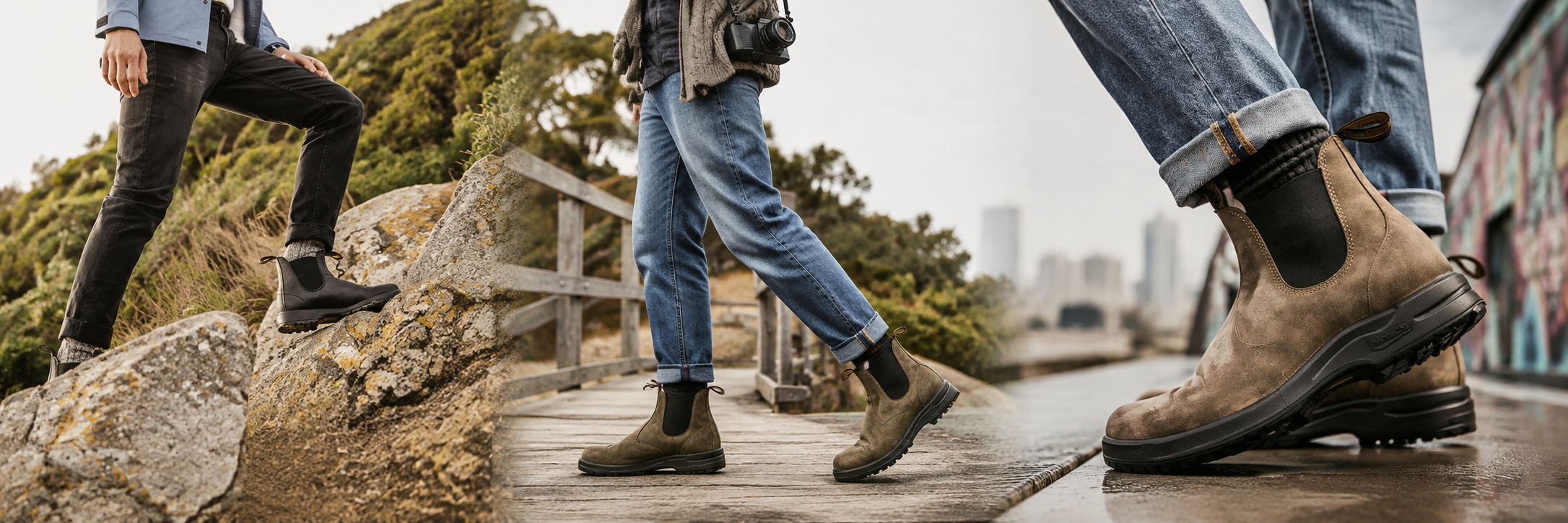
What a 155-year-old footwear icon can teach any brand about scaling on Amazon the right way.
Most heritage brands don’t have an Amazon demand problem. They have an Amazon control problem.
Blundstone is a perfect example. Founded in 1870 in Tasmania, Australia, the brand has spent more than a century earning a reputation for durable, do-everything footwear — from the iconic Chelsea boot to everyday essentials worn by people who genuinely put them through it. The demand was never in question. Customers were actively searching for Blundstone on Amazon every single day.
The problem was what happened after they searched.
Unauthorized sellers were fighting over the Buy Box. Listings were riddled with sizing irregularities. Duplicate detail pages were splitting reviews and traffic across the catalog. And the return rate had climbed past 50% — a silent margin killer that turned every sale into a coin flip on profitability.
This is how The Lion Group fixed the foundation and drove a 918% jump in Amazon revenue while cutting returns by more than half.
A great brand, undermined by a messy marketplace.

Unauthorized sellers had taken over. More than 35 rogue sellers were listing Blundstone products, eroding pricing, degrading the customer experience, and stripping the brand of control over how it showed up. On Amazon, whoever controls the Buy Box controls the brand — and Blundstone wasn’t the one holding it.
The listings were working against the product. Sizing was inconsistent and confusing. Blundstone uses AU sizing conventions that don’t map cleanly to how US shoppers think about fit, and nothing on the page was bridging that gap. Duplicate listings scattered demand and buried social proof. Photography and content didn’t reflect the quality of the product in the box.
Returns were over 50%. This was the symptom that tied everything together. When shoppers can’t figure out their size, they order two, keep one, and send one back — or worse, get it wrong and return both. Every one of those returns carried real cost: return shipping, processing, lost inventory, and a bruised organic ranking. A 50%+ return rate doesn’t just hurt margins; it quietly caps how much a listing can ever scale.
These are foundational problems, and foundational problems don’t fix themselves as you scale — they compound.
More traffic alone wouldn’t have solved any of it; it would just have poured more shoppers into a leaky funnel.
So we rebuilt the foundation first.
The Turnaround: fix the foundation before you scale the spend
Everything below was possible because of how we work. The Lion Group isn’t an ads agency — we’re a full retail partner. We purchase Blundstone’s inventory outright, warehouse it, ship it, and manage the entire marketplace operation on Amazon. That ownership model is the reason we could move fast and decisively: when you own the inventory and control the account, you can enforce pricing, restructure the catalog, and rebuild listings without waiting on anyone — and you carry the same risk your partner does, which keeps everyone’s incentives aligned.
1. We locked down the marketplace through Amazon’s Transparency Program
The single most important move was reclaiming control of who could sell Blundstone on Amazon. We enrolled the brand in Amazon’s Transparency Program and, using IP enforcement, cleared out 35+ unauthorized sellers until The Lion Group became the sole authorized seller. As that sole seller, we now buy, warehouse, and ship every unit ourselves — giving us end-to-end control over pricing, availability, and the customer experience. From there, we enforced MAP pricing across every SKU to stop the price erosion and restore retailer trust.
Here’s the part most brands underestimate: getting listings approved and gated through the Transparency Program is not a plug-and-play process. It’s slow, documentation-heavy, and unforgiving of mistakes. A single misstep in enrollment, GTIN mapping, or brand-registry alignment can stall a catalog for weeks and, in some cases, temporarily suppress the very listings you’re trying to protect. Brands that attempt this without knowing the internal requirements often end up worse off than when they started — gated products that won’t go live, and a support queue that moves at its own pace.
Knowing how to navigate that process — and how to sequence it so the catalog never goes dark — is exactly where experience pays for itself.
2. We fixed fit with specialty sizing and a cleaner catalog
Sizing was the root cause of the return problem, so we went after it directly. Blundstone was granted access to additional beta testing available only to select sellers, which allowed us to get specialty sizing names embedded directly into the listings — the kind of granular, fit-specific detail that isn’t available through standard listing tools. This gave shoppers clarity on how Blundstone sizing actually translates to their feet, before they hit “Buy.”
At the same time, we merged duplicate listings to consolidate reviews, traffic, and ranking signal onto single, authoritative detail pages, and reworked listing variations with US, EU, and UK sizing charts so fit was clear across every style.
The payoff was immediate and measurable: the return rate dropped from over 50% to under 20%. That’s not a cosmetic win — it’s margin, ranking, and inventory efficiency all moving in the right direction at once.
3. We rebuilt the listings front and back — and we keep rebuilding them
With control and fit handled, we rebuilt the customer-facing experience from the ground up: upgraded lifestyle photography, optimized A+ content, keyword-driven titles, and a storefront designed for discovery and conversion. Behind the scenes, we optimized the technical side of every listing — the back-end fields, attributes, and keyword architecture that determine whether a product even shows up in the right searches.
Crucially, this isn’t a one-time project. We fully optimize each listing on the front and back end and revisit it with quarterly updates, because Amazon’s algorithm, competitive landscape, and search behavior never stop moving. A listing that’s perfectly optimized in Q1 is average by Q3 if no one is tending to it.
Real Results. Lasting Impact.
Once the foundation was solid, performance didn’t just recover — it compounded.
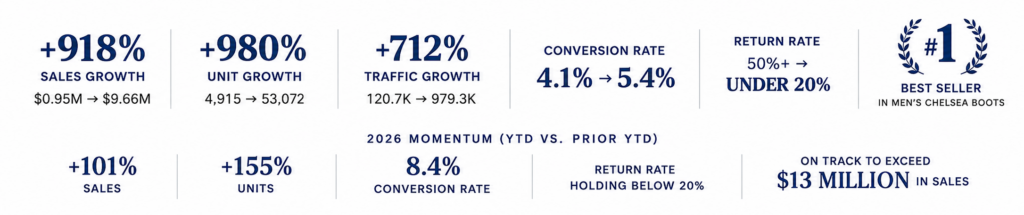
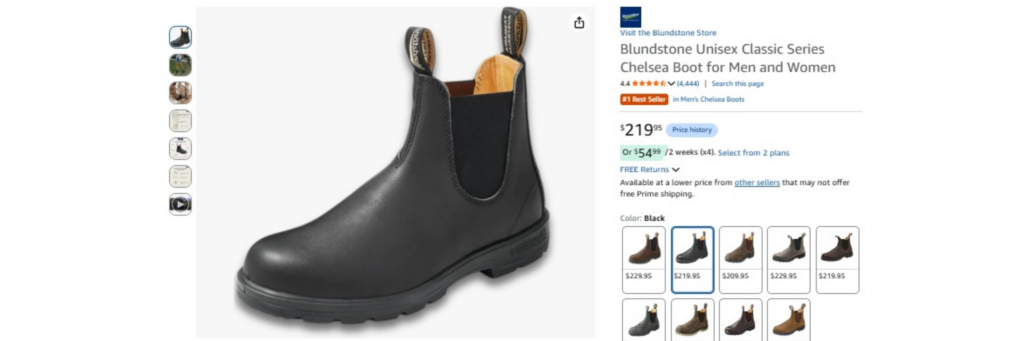
Most tellingly, Blundstone became the #1 Best Seller in Men’s Chelsea Boots — a ranking that reflects not a one-time spike, but the kind of clean listing, Buy Box control, and organic velocity that keep compounding on themselves.
What This Means For Your Brand
The Blundstone story isn’t really about boots. It’s about a truth that applies to nearly every established brand on Amazon: your biggest growth lever is usually control. Control over who sells your products, control over how your fit and quality are represented, and control over the technical foundation that decides whether you’re found at all.
That’s the difference between an agency and a true retail partner. The Lion Group doesn’t just run ads and send a report — we sell, warehouse, ship, and manage your business across Amazon, Walmart, SHEIN, Temu, and now Target. We buy your inventory outright, protect your brand, rebuild your listings, and treat your P&L like our own, because we only win when you do. The hard, unglamorous work — Transparency enrollment, seller enforcement, sizing beta programs, duplicate merges, quarterly back-end optimization, plus the logistics and fulfillment behind every order — is precisely the work that separates a brand that plateaus from one that grows 918%.
If your brand has strong demand but a messy marketplace, that gap is your opportunity.
Great brands go further with the right partner. Let’s build what’s possible.

The Lion Group — Real growth. Lasting impact.
Catherine Almodoval,
Global Partnerships Director
catherine@theliongroup.net
